Every AI we use today is raised on us. It learns from our photographs, our words and our labels, and so it inherits our categories: how we divide the world, what we name, what we ignore.
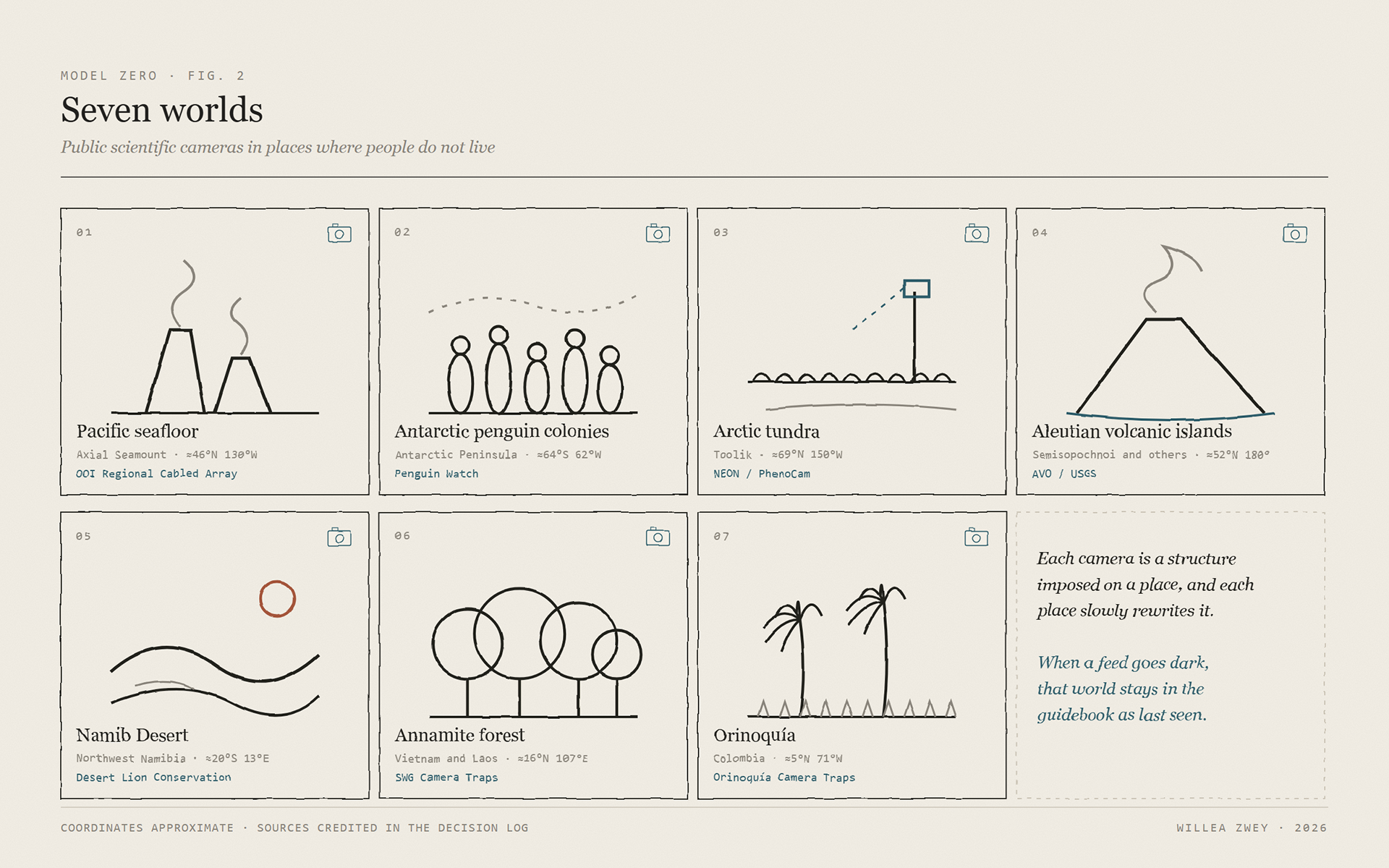
Model Zero is raised as far from us as it can be. It is a small vision model trained from scratch, with no pretrained weights, no text and no human labels. It learns only by watching, through live and archival footage from scientific monitoring cameras in places where people do not live: a hydrothermal vent on the Pacific seafloor, penguin colonies in Antarctica, the Arctic tundra, uninhabited volcanic islands in the Aleutians, the Namib Desert, and remote forests in Vietnam, Laos and Colombia.
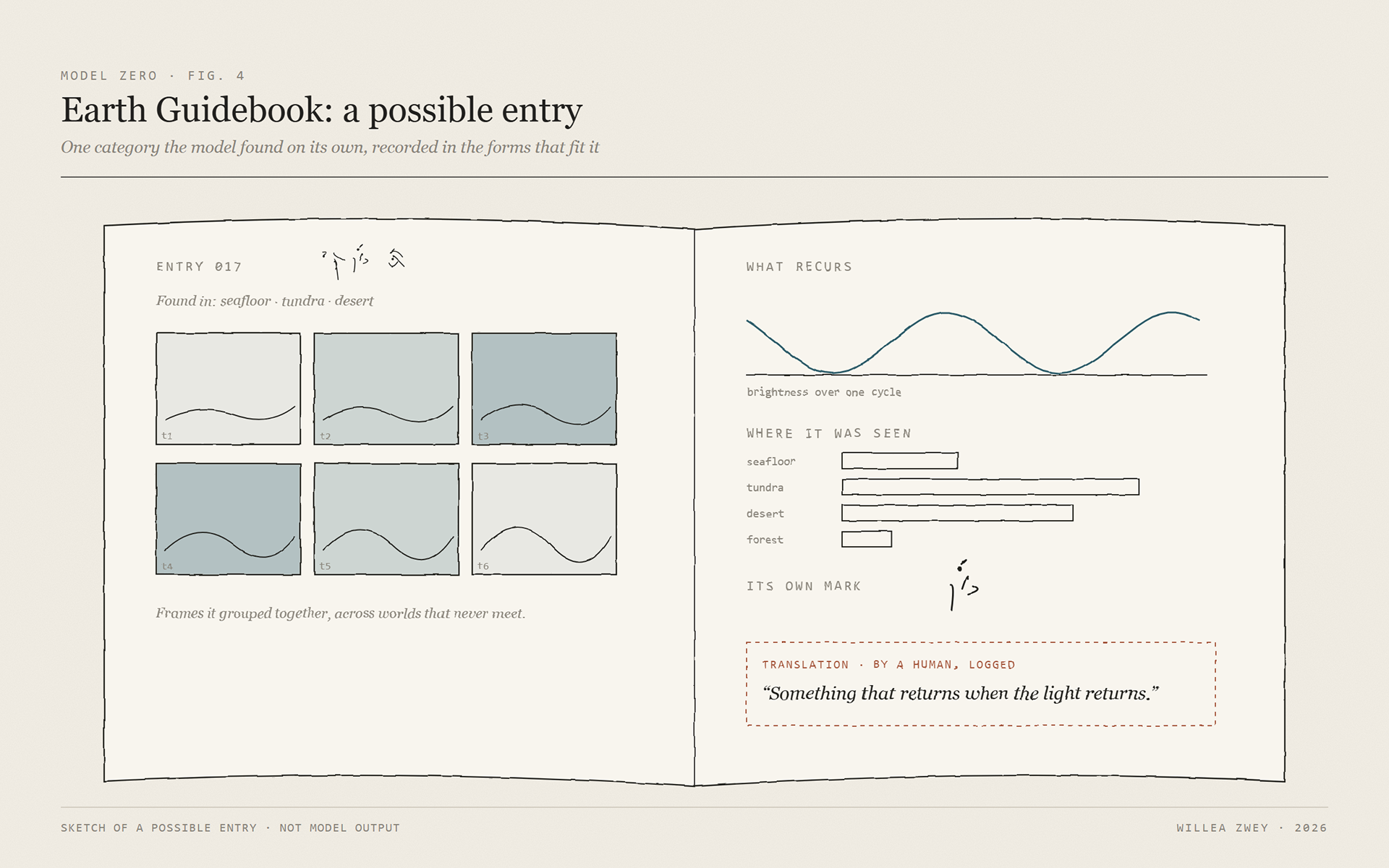
From what it sees, it sorts what recurs into categories of its own and records them in an evolving Earth Guidebook : a field guide to our planet for anyone who has never met us. It is something like an inverted Voyager Golden Record. Instead of humanity describing itself to the universe, a machine describes the Earth without us.

HOW IT LEARNS
From scratch.
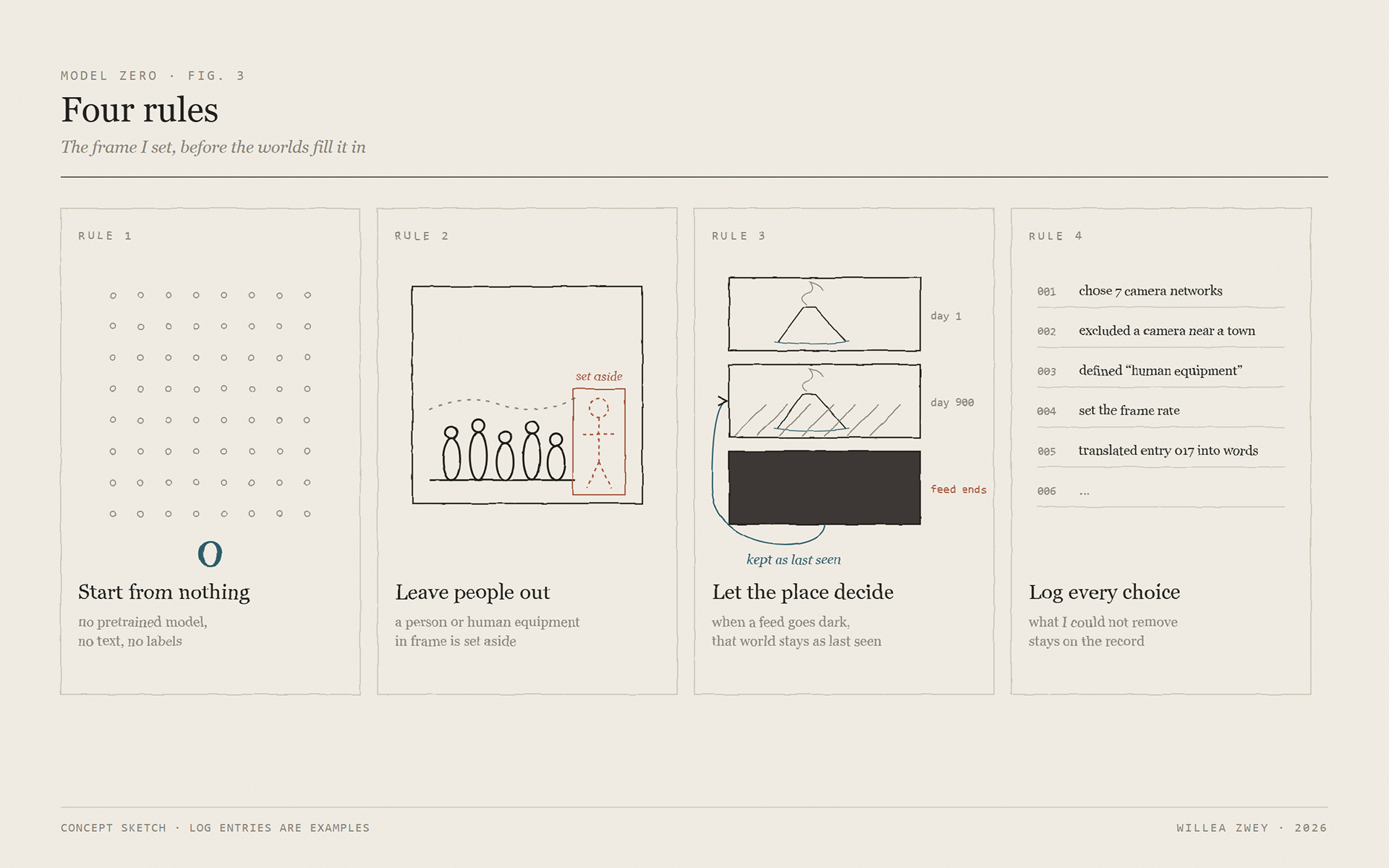
The model starts from nothing. It borrows no pretrained model and reads no text, so it does not inherit what the internet already "knows."
**By observation alone.** Training is self-supervised: the model learns by predicting and comparing what it sees across frames, places and time, rather than from human labels. Over time it forms its own groupings, which become the guidebook's entries.
**Continually.** Learning does not stop at a finished dataset. Live feeds keep adding new days, seasons and events, and the model keeps learning, while trying not to forget the worlds it met first.
**Without us in the picture.** People are not part of what it learns from. When a person or a piece of human equipment appears in a frame, the model sets it aside. Humans appear in the guidebook only once: as the thing it was told not to look at.
**Shaped by the places themselves.** Each camera is a structure imposed on a place, and each place slowly rewrites it: life colonizes the vent, snow buries the colony, sand and fog blind the lens. When a feed goes dark, that world stays in the guidebook as it was last seen.
The Earth Guidebook
The guidebook is the work's public form, published online and in print as it grows. Each entry is one category the model found on its own, recorded in whatever form fits it: sequences of frames, diagrams, measurements of light, color and motion, and a script of its own marks.
A model trained without language cannot write in English. Where words appear in the guidebook, they are a translation, made by people or tools that already carry human language, and the translation is marked as such. That gap between what the machine found and how we put it into words is part of what the work studies.
The decision log
Removing people from a machine completely is impossible. Someone chooses the cameras, writes the rules and decides what counts as human. Model Zero makes these choices visible instead of hiding them.
A public decision log sits beside the guidebook and records every human choice the model still depends on: which cameras it watches and why, what it sets aside, how its entries are translated, and when its learning ends. The log shows exactly where I could not step out of the machine.
The guidebook is a way to look at the Earth with our influence turned down as far as possible. The log is a test of authorship: how far a human can step back from a machine, and what of us remains.
Seven worlds
Planned camera sources, all public scientific monitoring programs:
| World | Source |
| Pacific seafloor, Axial Seamount | Ocean Observatories Initiative, Regional Cabled Array (CAMHD) |
| Antarctic penguin colonies | Penguin Watch time-lapse cameras |
| Arctic tundra, Toolik | NEON and PhenoCam Network |
| Aleutian volcanic islands | Alaska Volcano Observatory / USGS webcams |
| Namib Desert | Desert Lion Conservation camera traps (via LILA BC) |
| Annamite forest, Vietnam and Laos | SWG Camera Traps (via LILA BC) |
| Orinoquía, Colombia | Orinoquía Camera Traps (via LILA BC) |
Each source is credited in the guidebook, used under its own terms, and listed in the decision log.
*Model Zero is in development. For collaboration or research inquiries: willzwey@gmail.com*